Key Conclusion
No single agricultural shade net product is suitable for every project.
Open-field vegetable crops, orchards, standard greenhouses, modern greenhouses, livestock shelters, and privacy screens have different needs.
These needs include ventilation, strength, reflectivity, durability, and installation methods.
The best order to choose is: use case, install method, climate, product design, shading rate, service life, and total cost.
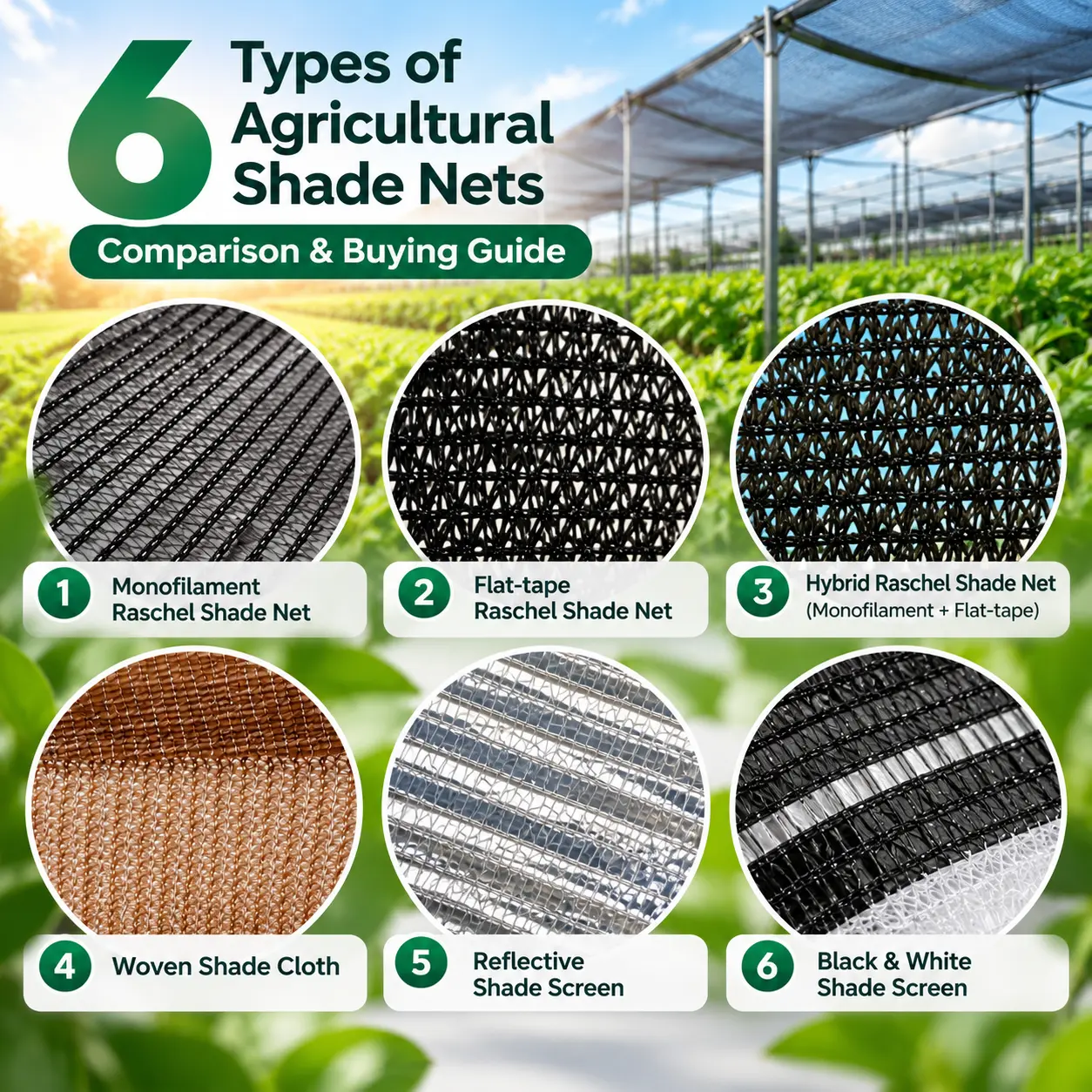
This article outlines the structure, performance, application scenarios, and selection criteria for six common types of agricultural shade nets.
The key point is this: when choosing a shade net, first identify the use and structure.
Then choose the right shading rate.
Do not just compare prices or shading percentages.
Quick Comparison of Six Shade Net Type
| type | Key Features | Application Scenarios | Typical Lifespan |
|
Monofilament shade net |
Strong, breathable, wind-resistant. It suits long-term fixed installation. |
greenhouses, orchards, livestock shelters |
lasts 7–10 years. |
|
Flat-tape Raschel |
Lightweight, economical High Shade, Low Weight |
Vegetables, fruit trees, flowers, seasonal shading |
lasts 3-5 years |
|
Monofilament & Flat-tape |
Balanced strength, shading effect, and cost | Nurseries, garden shade structures | lasts 5-8 years |
|
Woven Shade Cloth |
Smooth surface, high shading rate; relatively lower ventilation | Windbreaks, privacy screens, vehicle shading | lasts 3-5 years |
|
Aluminum foil shade net |
eflects sunlight and improves light spread in greenhouses. | modern greenhouses, seedling raising, flower cultivation. | lasts 5-7 years |
|
Black-and-White Screen |
The white side reflects light during the day. The black side helps keep heat at night. |
Best for greenhouses that need temperature control all year. | lasts 5-7 years |


Main Materials and Structures of Agricultural Shade Nets
materials
Agricultural shading materials primarily consist of polyester shade cloth and HDPE plastic shade nets.
Polyester shade cloth offers some water resistance but has relatively poor breathability.
HDPE shade nets are lightweight and breathable.
You can also treat them with UV stabilizers.
This makes them a common choice for farming and greenhouse projects.
Structures
Manufacturers categorize HDPE shade nets into Raschel knitted structures and woven structures based on their manufacturing structure.
Raschel knitted shade nets are soft and let air flow through the mesh.
This makes them good for shading crops, orchards, and greenhouses.
Woven shade nets have a flatter surface and a tighter structure.
But they usually let in less air than knitted types.
They are better for perimeter fencing, windbreaks, and privacy screens.
Six Common Types of Agricultural Shade Nets
1 Monofilament Raschel Shade Net
HDPE monofilaments knit monofilament Raschel shade nets.
They have a strong structure with excellent tensile strength and wind resistance.
They are suitable for long-term, fixed installation on greenhouses, orchards, livestock shelters, and other outdoor facilities.
A monofilament structure is often best for projects in areas with high UV exposure or strong winds.
It also helps when people do not want to replace shade nets frequently.
Its drawbacks include higher weight and upfront costs.
It also needs more labor for installation, removal, and storage.
2 Flat-Tape Raschel Shade Net
Flat-tape Raschel shade nets are knitted using flat HDPE tapes, allowing for high shading rates at a lower material weight.
They are suitable for shading vegetables, fruit trees, flowers, seedlings, and seasonal agricultural crops.
Their main advantages are light weight, ease of installation, and cost-effectiveness.
However, the flat-tape structure is generally less durable over time than the monofilament structure.
In high-wind areas or long-term fixed installations, the attachment points may tear more easily.
3 Monofilament and Flat-Tape Hybrid Raschel Shade Net
This product combines both monofilament and flat-tape structures.
Manufacturers use monofilaments to improve strength and tear resistance.
They use flat tapes to boost shading and manage costs.
Its performance and price usually fall between pure monofilament and pure flat-tape products.
This makes it suitable for nurseries and garden shade structures.
It also works well for carports, windbreaks, and privacy screens.
If greenhouse crops require precise control over light, ventilation, and temperature,
you should consider specialized greenhouse shade screens instead.
4 Woven Shade Cloth
Weave warp and weft threads to make woven shade cloth.
It has a fairly flat surface. It can provide high shading rates.
Suitable for windbreaks, perimeter fencing, privacy screening, vehicle shading, and certain outdoor facilities.
Use caution when you use it in enclosed or semi-enclosed greenhouses,
because its tight structure may restrict airflow.
For crops requiring good ventilation and heat dissipation,
Raschel-knitted shade nets are generally more appropriate.
5 Reflective Shade Screens
Reflective shade screens are typically composed of a combination of reflective materials and HDPE monofilament.
Their main difference from standard black shade nets is that they reduce heat in the greenhouse.
They do this by reflecting some solar radiation.
These products suit modern greenhouses, floriculture, seedling nurseries, and high-value crop production.
They can also improve light distribution within the greenhouse.
They usually cost more than standard shade nets.
The reflective surface needs cleaning to stay effective, since dust can reduce reflection.
6 Black-and-White Shade Screens
Black-and-white shade screens feature two-color surfaces, and growers mainly use them to manage greenhouse temperatures.
The white surface reflects a portion of solar radiation during the day, while the black surface helps absorb and retain heat at night.
They work well for greenhouse projects that need summer cooling and winter heat retention.
They usually need a manual or motorized retraction system.
For standard open-field agriculture or projects lacking retraction mechanisms,
the installation costs and operational complexity may be prohibitively high.
III. How to Choose the Right Shade Net
When selecting a shade net, consider the following factors in order:
1. Determine the installation method.
For permanent installations, focus on UV resistance, tensile strength, and wind resistance. For seasonal projects, choose lighter products that are easier to install and remove.
2. Determine the application environment.
Requirements vary for open-field vegetable crops, orchards, standard greenhouses, modern greenhouses, and livestock shelters. Do not choose based only on the shading rate.
3. Clarify the primary objective.
Distinguish between goals such as reducing intense light, controlling temperature, improving ventilation, mitigating heat stress, providing wind protection, or ensuring privacy.
4. Finally, determine the shading rate.
A higher shading rate is not always better. If it is too high, it may block too much light for crops.
If it is too low, it may not provide enough sun protection or cooling.
Determining the shading rate requires considering at least the following information:
Crop variety and growth stage
Local temperature, solar radiation, and UV intensity
Greenhouse or open-field cultivation environment
Installation locati0n, structural design, and ventilation conditions
Seasonal use versus permanent year-round use
IV. Key considerations for B2B procurement
Buyers should look beyond the price per square meter.
They should review materials, test data, production capacity, and project fit.
We recommend verifying the following:
Whether the raw material is HDPE and whether virgin or recycled material is used
Presence of UV stabilizers and specifications regarding suitable climates and expected service life
Consistency of shading rate, weight (gsm), mesh size, tensile strength, and dimensional tolerances
Availability of test data for shading rate, tensile strength, weather resistance, etc.
Suitability for the project site's wind, temperature, and UV conditions
Availability of pre-production samples or samples from the actual batch
Whether roll width and length match project dimensions, minimizing seams and installation labor
Availability of clips, hooks, ropes, and other installation accessories
Procurement decisions should also factor in long-term costs.
A cheaper shading net that needs frequent replacement may cost more over time.
These costs include materials, transport, removal, and re-installation.
A net with a slightly higher upfront price may last longer and cost less overall.
V. Basic calculation of shading net quantity
You can estimate the base area for shading net procurement like this.
Multiply the coverage length by the coverage width.
Then add extra material for edge overlaps and cutting waste.
Before you place an order, confirm the quantity. Base it on the fastening method.
Consider the roof curvature. Check the wind load allowances. Confirm the site dimensions.
Shading net procurement area = Coverage length × Coverage width + Overlap allowance + Cutting waste
Selecting the right roll width is equally important. The more closely the roll width matches the greenhouse or shade structure, the fewer seams you need. This usually speeds up installation and reduces weak points in the structure. Conclusion
For seasonal vegetable and fruit tree shading, lightweight and cost-effective flat-tape Raschel shade nets are a top option.
For permanent setups or areas with high UV exposure or strong winds, consider durable monofilament Raschel shade nets.
For modern greenhouses that need precise temperature and light control, reflective shade screens are a suitable choice.
For greenhouses that need year-round temperature control, black-and-white shade screens need further evaluation.
Ultimately, choose specific products based on the crops, local climate, installation setup, and supplier test data.